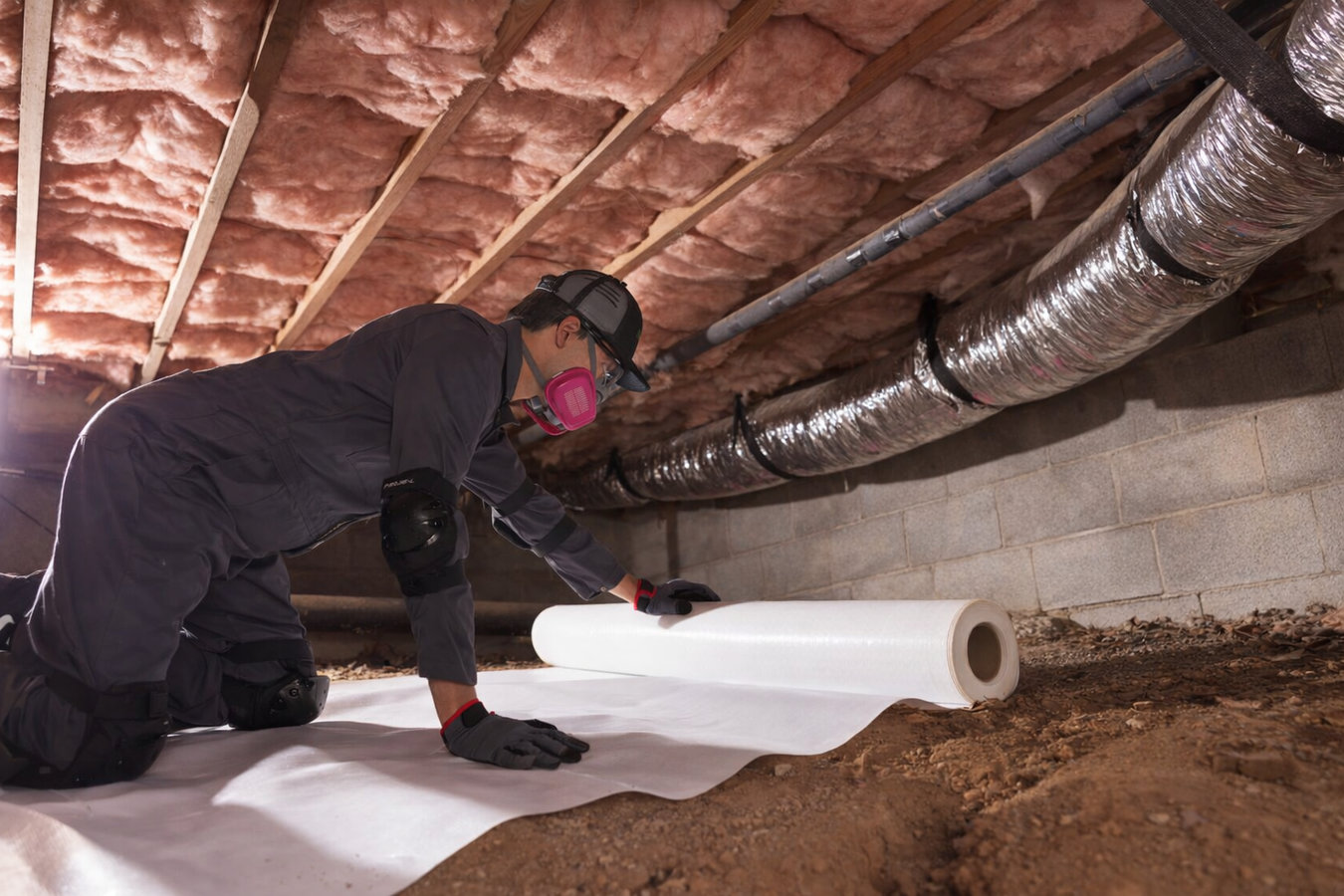
Ground moisture rising through crawl spaces and basement walls does real damage over time. A properly installed vapor barrier stops it before it reaches your wood framing and living areas.
Ground moisture rising through crawl spaces and basement walls does real damage over time. A properly installed vapor barrier stops it before it reaches your wood framing and living areas.
Vapor barrier installation in Cape Girardeau places heavy-duty plastic sheeting across the bare soil of a crawl space or against basement walls to block ground moisture from moving into the structure - most jobs complete in one day with no need to leave the home during the work.
The barrier itself is a thick, durable polyethylene sheet - usually gray or black - that feels similar to a heavy-duty tarp. It blocks moisture vapor from the ground before it can evaporate upward into floor joists, insulation, and the living areas above. In Cape Girardeau's climate, where summers are genuinely humid and the ground holds moisture well into dry spells, that upward moisture movement is a persistent problem rather than a seasonal one.
If your crawl space already has a ground barrier but you are also losing heat through the floor joists, pairing vapor barrier work with crawl space vapor barrier and wall insulation in one visit handles both concerns efficiently.
When moisture gets into the wood framing beneath your floors over a long period, it softens the wood and causes it to sag. If you notice a spot in your kitchen or hallway that feels a little bouncy or dips when you walk on it, that is often a sign that the subfloor has been absorbing moisture from below. In Cape Girardeau's humid summers, this process can happen faster than homeowners expect.
A persistent musty or earthy smell - especially in a basement, first-floor bathroom, or near floor vents - is one of the most reliable signs that moisture is moving up from an unprotected crawl space. The smell tends to be worse in summer when the ground is warm. If you notice it after a stretch of hot, humid weather, the crawl space is the logical first place to look.
If you have looked into your crawl space and noticed water droplets forming on metal pipes or duct surfaces, that is moisture-laden air doing what it does in Cape Girardeau's climate - condensing on cooler surfaces. This is a sign the air under your home is far too humid. A vapor barrier is one of the most direct ways to address the ground moisture feeding that problem.
Many older homes in Cape Girardeau's established neighborhoods were built without crawl space moisture protection as a standard feature. If you have owned an older home for years and no one has ever mentioned the crawl space, there is a real chance it has bare soil with no barrier at all. This is not a crisis, but it is worth checking - especially in a climate that pushes as much moisture into the ground as this one does.
Our vapor barrier installation process starts with a thorough inspection of your crawl space or basement to assess what is actually there - soil condition, any standing water, existing insulation or debris, and how tight or accessible the space is. Based on that assessment, we specify the right material thickness, typically 10-mil or heavier for Cape Girardeau homes given the local moisture conditions. We lay the sheeting across the full floor with overlapping seams, tape every joint, and secure the edges up the foundation walls so there are no gaps for moisture to sneak through.
We also handle vapor barriers in basement wall applications and below-grade assemblies where ground moisture threatens the wall structure rather than the floor above. If you need a higher level of protection, we can discuss full crawl space encapsulation - which pairs the ground barrier with wall coverage and a dehumidifier. For homeowners who also want to address heat loss at the same time, our attic air sealing and general moisture management services work well in combination. And for a focused crawl space ground barrier specifically, our crawl space vapor barrier page walks through that service in more detail.
Best suited for homes where ground moisture is the primary concern and the crawl space floor is bare soil or has an old, degraded barrier that needs replacement.
Best suited for homes with below-grade basement walls that face ground moisture pressure, particularly in Cape Girardeau's older neighborhoods near the river corridor.
Best suited for homes where the crawl space contains old fallen insulation, debris, or a degraded existing barrier that must be removed and cleared before new material goes down.
Best suited for homes with persistent moisture issues or homeowners who want the highest level of protection, combining a ground barrier with wall coverage and active dehumidification.
Cape Girardeau sits along the Mississippi River, and the surrounding lowland geography means the water table in many parts of the city is closer to the surface than it would be in an inland location. A higher water table puts more pressure on ground moisture to move upward - which makes vapor barrier quality and proper seam sealing especially important here. This is not just a concern for homes near the riverfront. It affects homes across the city wherever the soil stays saturated after spring rain events. The Missouri Department of Natural Resources tracks groundwater conditions across the region, and the clay-heavy soils of southeast Missouri are well documented as contributing to persistent moisture issues in residential structures.
We install vapor barriers in homes across Cape Girardeau and throughout the surrounding region, including communities in Dexter and Kennett where the same Mississippi River basin soils and humid climate create identical moisture challenges for homeowners. The combination of older housing stock - much of it built before moisture protection was standard - and a genuinely difficult moisture environment makes this one of the more important services we provide in this region.
We reply within one business day. A brief conversation about your home and any symptoms you have noticed helps us come prepared. You do not need to know the square footage of your crawl space - we will measure it ourselves.
We get into the crawl space and look at what is actually there - soil condition, any standing water or debris, the state of existing insulation, and how accessible the space is. This takes 30 to 60 minutes and is the basis for a written quote. We do not give firm numbers without seeing the space first.
The crew arrives and works in the crawl space - you do not need to do anything special or be in a particular part of the house. They lay the sheeting across the full floor, overlap and tape the seams, and run the material up the walls where needed. Most jobs are finished in a single day.
Before we leave, we walk you through what was installed - either showing you photos or taking you to the access point so you can see the finished barrier yourself. There is no curing time. You will notice the musty smell beginning to fade within a few days as the moisture source is cut off.
Free on-site inspection. Written estimate. We reply within one business day. No obligation to move forward after the quote.
(573) 381-9088We do not use a single standard material for every job. Homes near the river corridor or in low-lying areas with higher ground moisture pressure get heavier-duty material than standard. We specify thickness based on what your crawl space actually faces - not what is cheapest to install.
The most common reason vapor barriers fail is unsealed or poorly overlapped seams that allow moisture to pass through the joints. We overlap every seam by at least 12 inches and tape every joint before securing the perimeter. If you can see bare soil anywhere after the job, that is a sign the work was not finished correctly - and you will not see that on our jobs.
We have worked in crawl spaces throughout Cape Girardeau County and the surrounding southeast Missouri and southern Illinois region. Understanding how the local water table, clay soils, and seasonal flooding patterns affect what a vapor barrier needs to do here is different from general contractor knowledge - it comes from working in these specific conditions.
We give you a free written estimate up front and document the finished vapor barrier before we leave. You can verify full coverage and sealed seams yourself, and we expect you to check the work before we call it done - any reputable contractor will.
The work we do in crawl spaces is not visible from inside your home, which is exactly why we walk every customer through what was installed before we leave. You hired us to protect your home - you deserve to be able to verify the job was done right.
Sealing attic bypasses and penetrations to stop conditioned air from escaping and outdoor air from infiltrating through the ceiling plane.
Learn moreFocused crawl space ground barrier installation to block soil moisture from reaching floor joists and the living areas above.
Learn moreCape Girardeau's spring rain season fills contractor schedules fast - schedule your free crawl space inspection now and get your estimate before demand peaks.